
Your AI Research Assistant for Publication-Ready Papers
StatsPAI empowers researchers with AI-assisted tools for paper outline planning, literature review synthesis from uploaded PDFs, and rigorous statistical modeling — dramatically accelerating your path from data to publication.


StatsPAI, together with LearnPy.online and CoPaper.AI, is committed to rapidly making Python the #1 language for empirical research
Traditional empirical research requires literature review, data cleaning, statistical modeling, and full paper writing — a tedious and time-consuming process. StatsPAI's AI assistant works alongside you — helping structure your paper outline, generate 100% reliable literature reviews, build econometric models, refine your analysis, generate fully formatted papers, and provide Python/R/Stata code for full reproducibility. Let AI handle the tedious groundwork so you can focus on research and innovation, gaining insights into the past, present, and future.

Bryce Wang @Stanford REAP
Founder
Researcher and engineer focused on Agentic AI and statistical empirical analysis. Author of "Building Intelligent Multi-Agent Systems".
Expertise

Scott Rozelle, PhD @Stanford REAP
Cofounder & Strategic Advisor
Helen F. Farnsworth Senior Fellow at Stanford University and Faculty Co-director of the Stanford Center on China's Economy and Institutions. Leading expert on agricultural policy, rural development, and education economics in China. Author of "Invisible China" and recipient of China's Friendship Award.
Expertise
Our Mission
We believe empirical research should be accessible to everyone. By combining cutting-edge AI technology with deep statistical expertise, we're removing the technical barriers that prevent researchers from focusing on what matters most: asking the right questions and interpreting results.
Democratization
Making professional research tools accessible to researchers worldwide
Quality
Maintaining the highest standards of statistical rigor and methodology
Innovation
Pushing the boundaries of what AI can achieve in empirical analysis
Our Product Ecosystem
Three Platforms, One Mission
From the open-source foundation to the AI research assistant to free learning — we cover the full stack of empirical research in the AI era.

AI Research Assistant — Plan · Estimate · Iterate · Paper
Your AI-powered research assistant for academic paper writing. From outline planning to empirical data analysis and full paper generation — produce publication-ready work efficiently.

Agent-Native Causal Inference · 800+ Functions · One import
The open-source Python package that consolidates Stata and R's causal inference ecosystems into one agent-native API — purpose-built for LLM-driven research and fully ergonomic for humans.
LearnPy.online
Free Interactive Learning
Interactive platform for learning Python, statistics, and econometrics. Code in your browser, get AI assistance, and build skills from basics to advanced topics.
All three platforms designed to democratize access to advanced statistical analysis in the AI era
Core Features
Powered by Advanced AI
Everything you need for professional empirical research
Automated Research Workflow
From data cleaning to final report generation, our AI handles the entire research process automatically.
Publication-Ready Output
Generate comprehensive DOCX reports with methodology, results, robustness checks, and discussion chapters.
Intelligent Analysis
Leveraging Claude 4.5 and GPT-5 for sophisticated statistical modeling and evidence-based insights.
Minutes, Not Months
Complete what traditionally takes weeks of work in just minutes with AI-powered acceleration.
Comprehensive Statistics
Descriptive statistics, baseline models, robustness checks, and advanced econometric analysis.
Democratized Research
No technical barriers. Focus on your research questions, not implementation details.
Free Interactive Learning Platform
LearnPy.Online
Master Python, Statistics, and Econometrics with interactive coding and AI assistance - completely free
Interactive Code Editor
Write and run Python code directly in your browser with instant feedback
AI-Powered Assistant
Get explanations, debug code, and learn concepts with intelligent chatbot support
Comprehensive Curriculum
From Python basics to advanced econometrics - structured learning paths
# Python Statistics Example
import numpy as np
import pandas as pd
from scipy import stats

# Generate sample data
data = np.random.normal(100, 15, 1000)

# Perform t-test
t_stat, p_value = stats.ttest_1samp(data, 100)

# Display results
print(f"T-statistic: {t_stat:.4f}")
print(f"P-value: {p_value:.4f}")100% Free - No Credit Card Required
From Data to Paper, Together
From data to paper. 20 minutes to a reproducible paper.
CoPaper.AI is the AI research co-authoring platform from Stanford's REAP program. Upload your data, set your research direction, and collaborate deeply with AI at every step to produce reproducible academic papers with full code — from OLS, Logit/Probit and mediation to DiD, IV, and RD.
38+
Econometric Methods
3,000+
Papers Assisted
200+
Universities Covered
5–30 min
Avg. Generation Time
Sample Outputs
38 econometric methods, publication-quality figures
Every figure below was generated end-to-end by CoPaper.AI — ready to drop straight into your .docx, untouched.
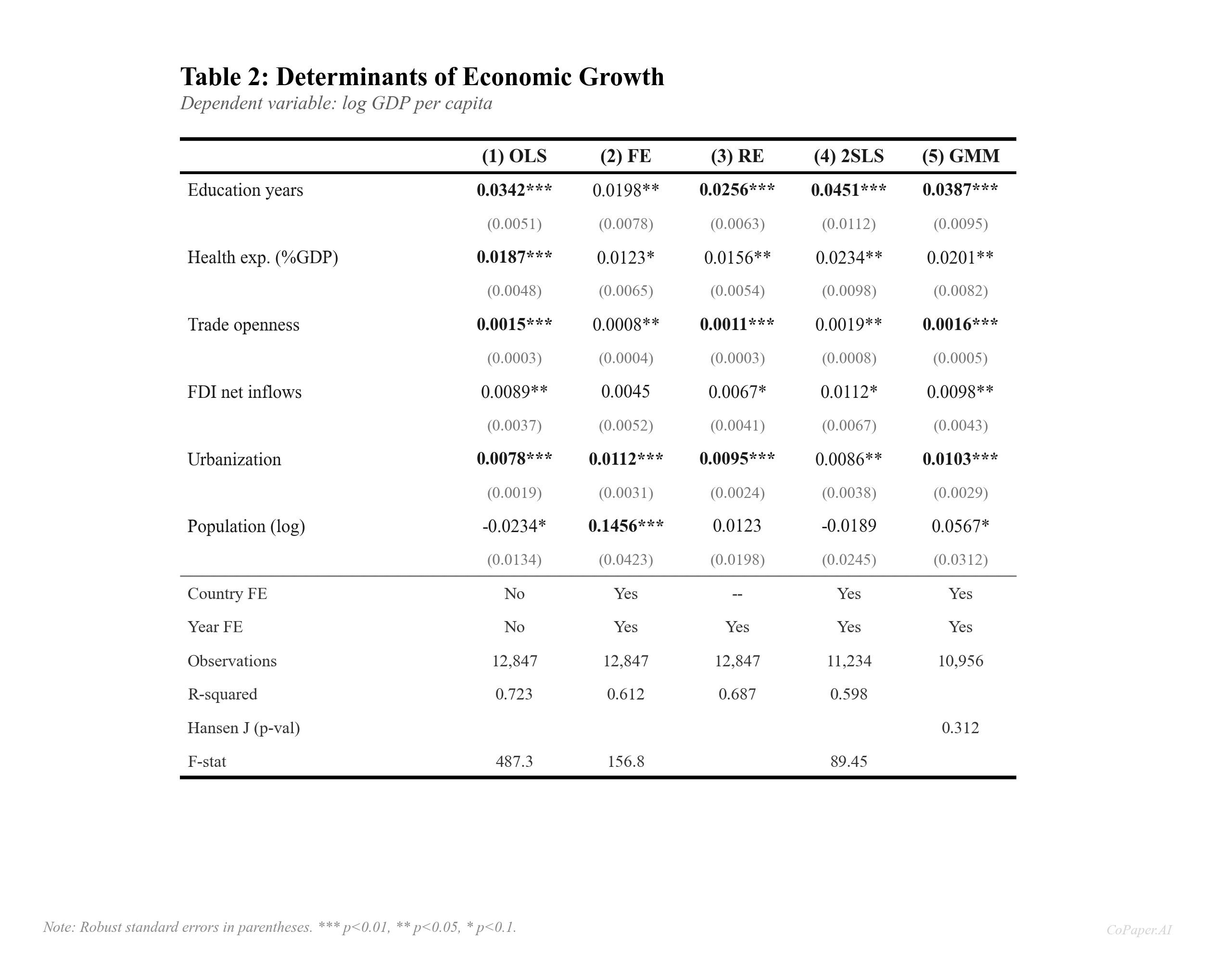
Multi-Model Regression Table
Side-by-side OLS / FE / RE / 2SLS / GMM with clustered SEs and standard diagnostics.
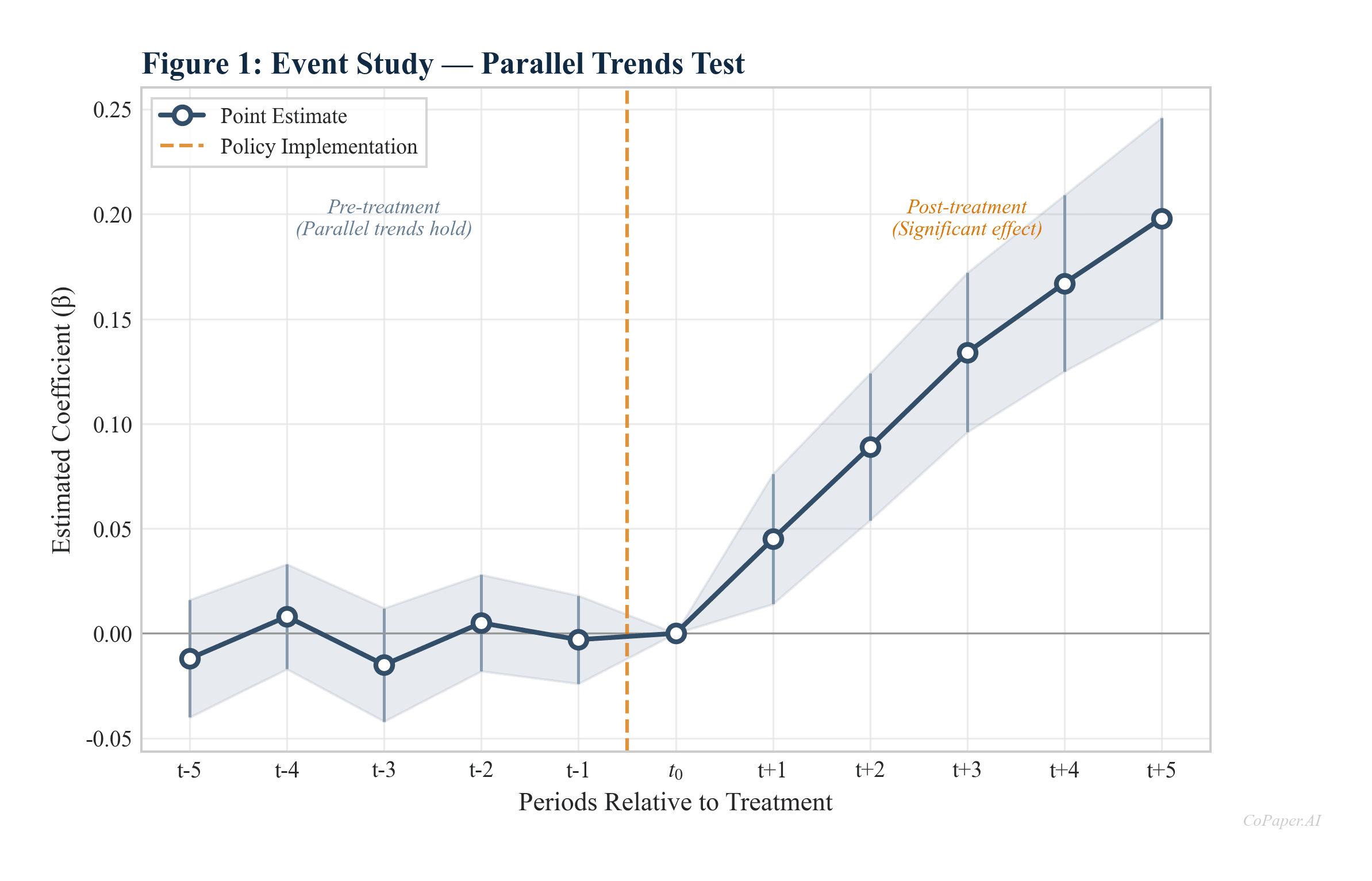
Event Study · Parallel Trends
Dynamic treatment effects with pre-period placebo coefficients and 95% CIs.
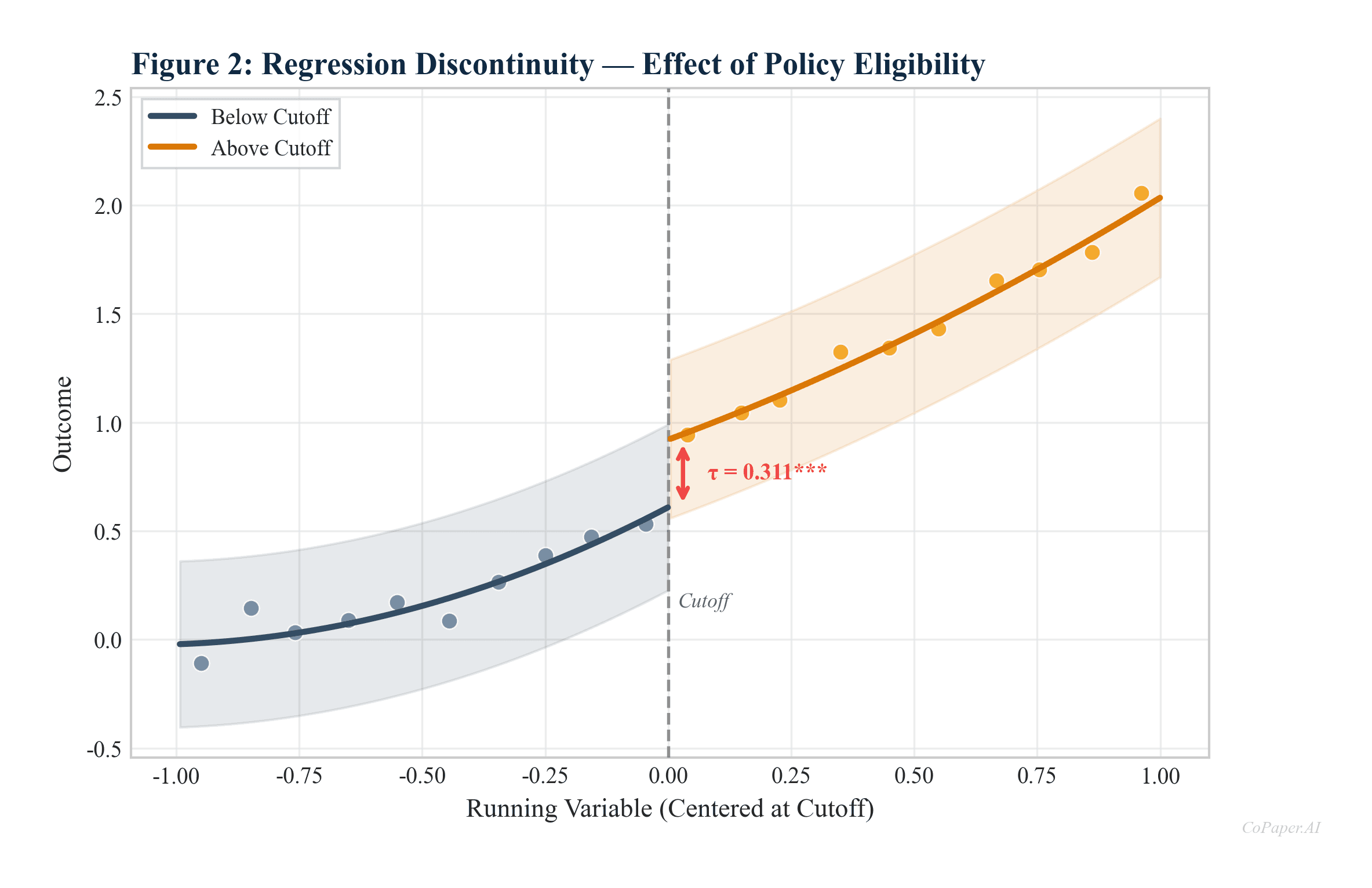
Regression Discontinuity
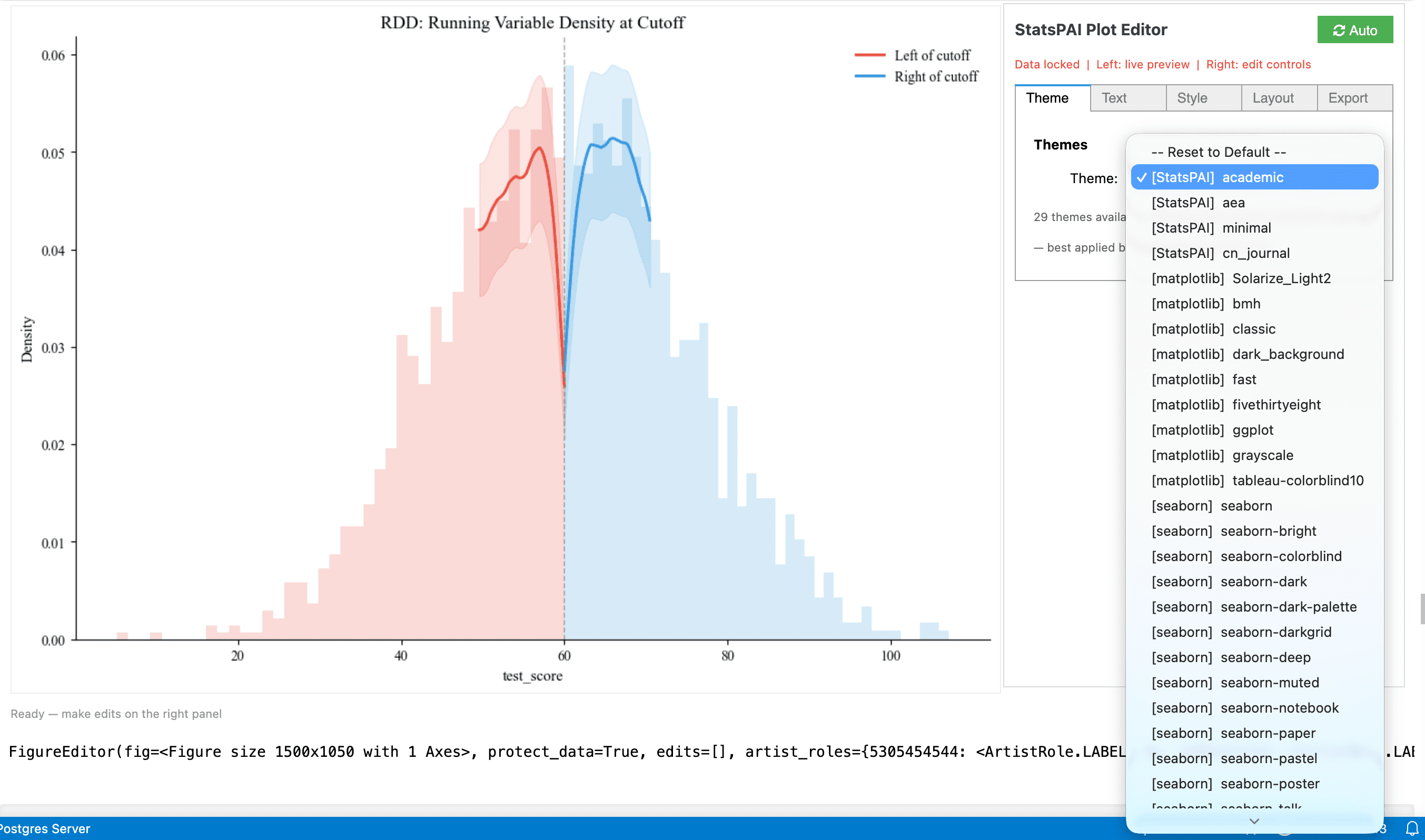
Binned scatter + local polynomial fit around the cutoff with robust bias-corrected inference.
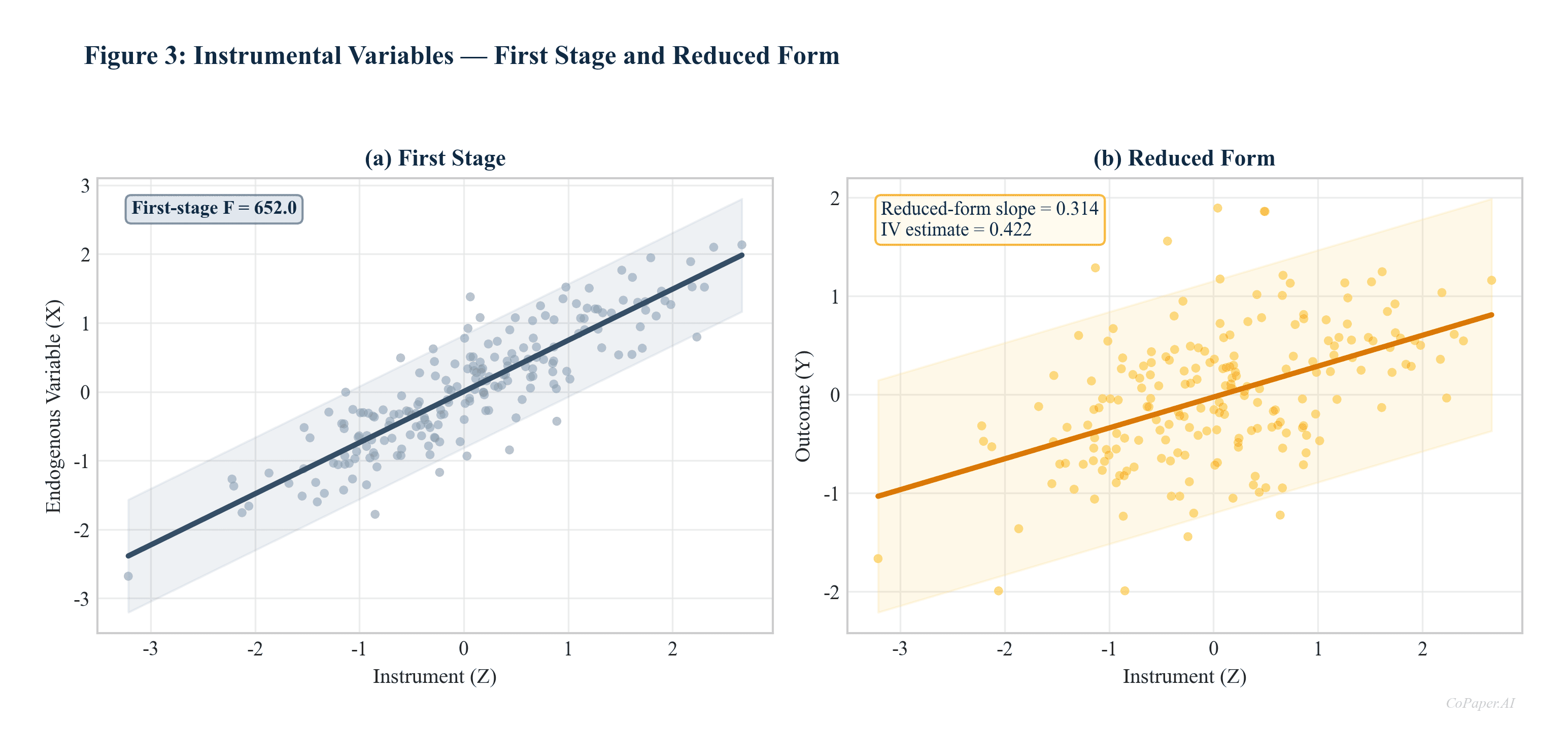
Instrumental Variables · 2SLS
First-stage F-statistic, reduced form, and 2SLS point estimates with weak-IV robust CIs.
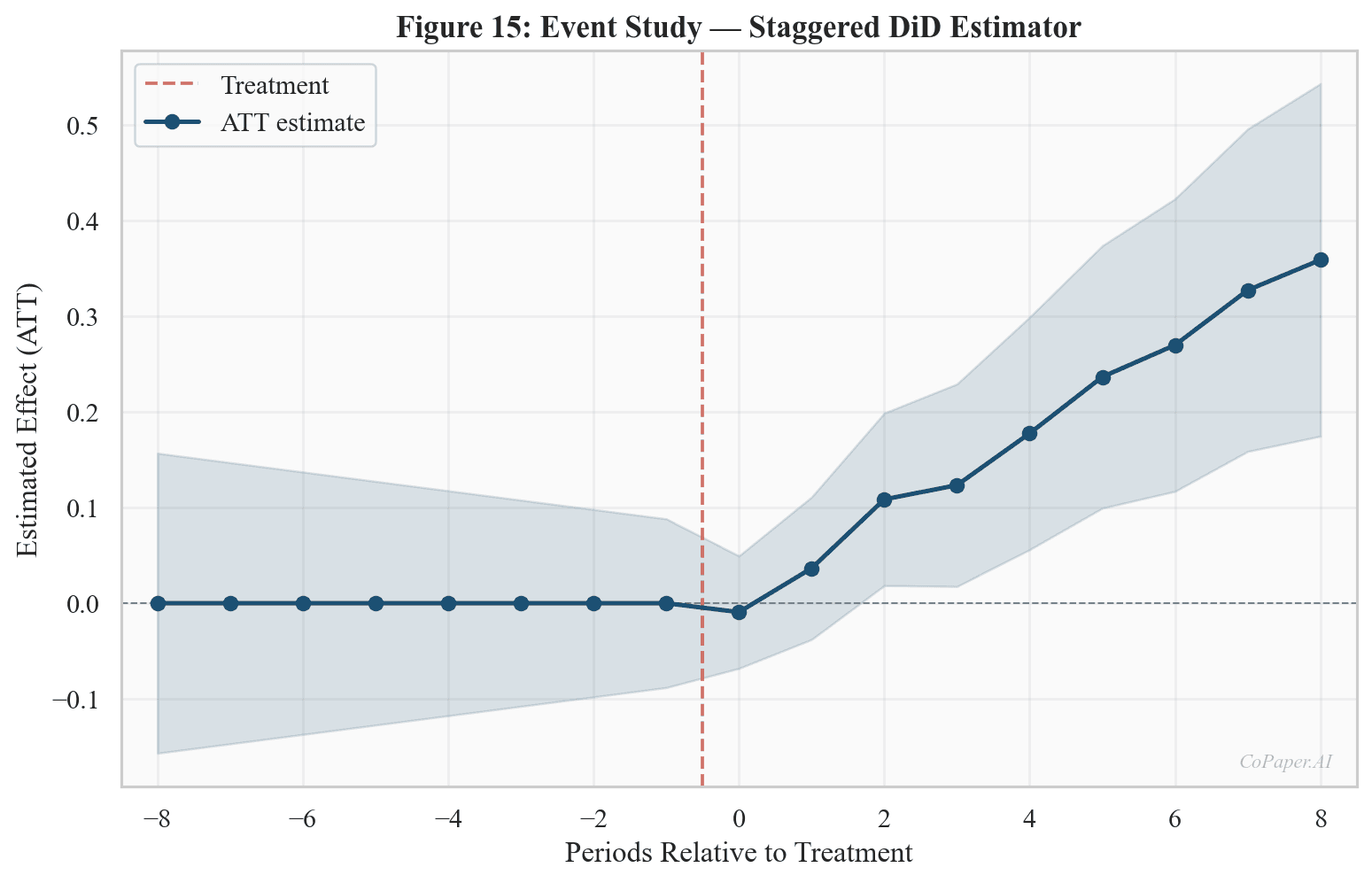
Dynamic Event Study
Lead-and-lag coefficients around policy implementation with point-wise and uniform bands.
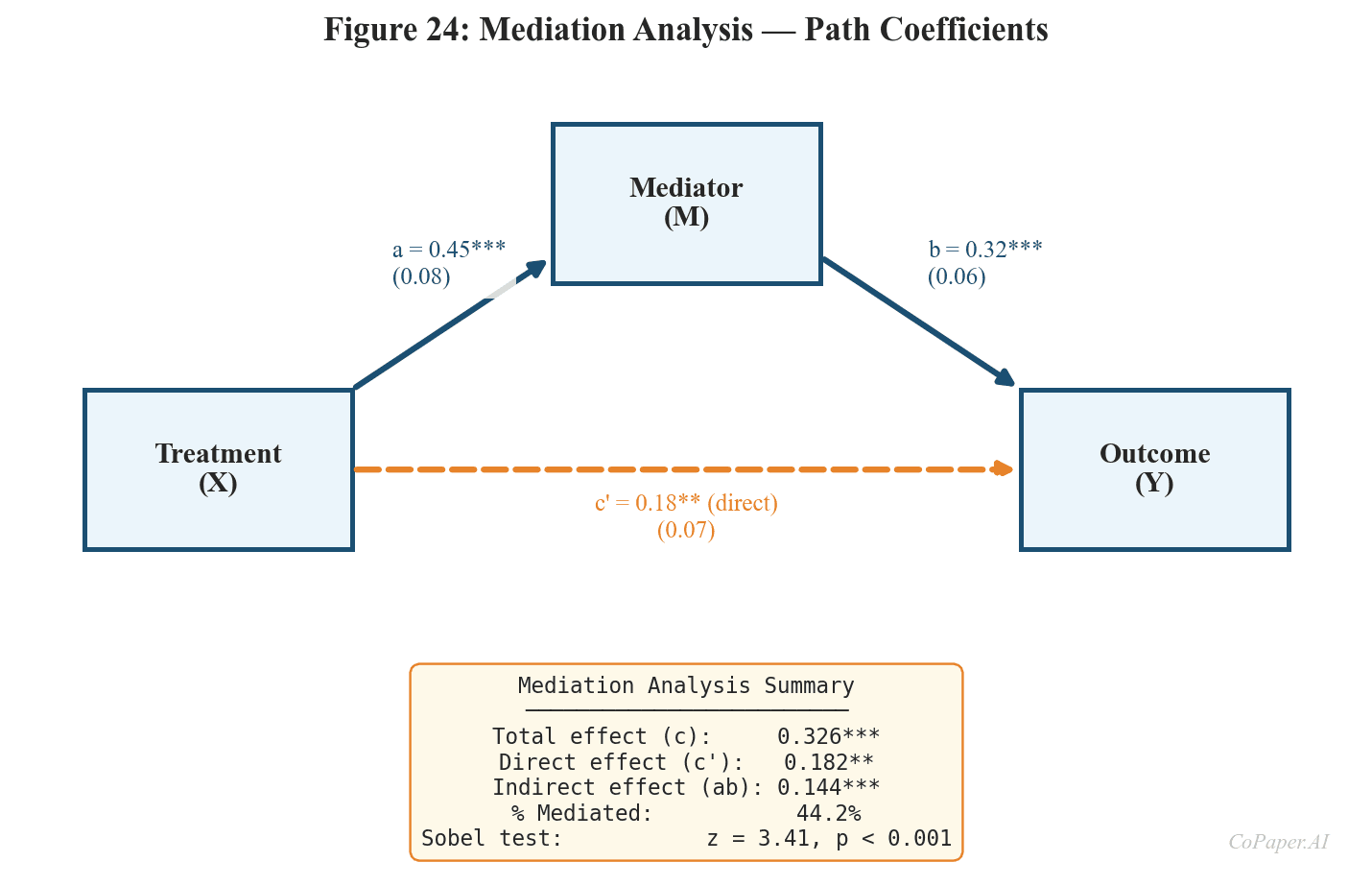
Mediation Analysis
Direct and indirect effects decomposition with bootstrap CIs and sensitivity diagnostics.
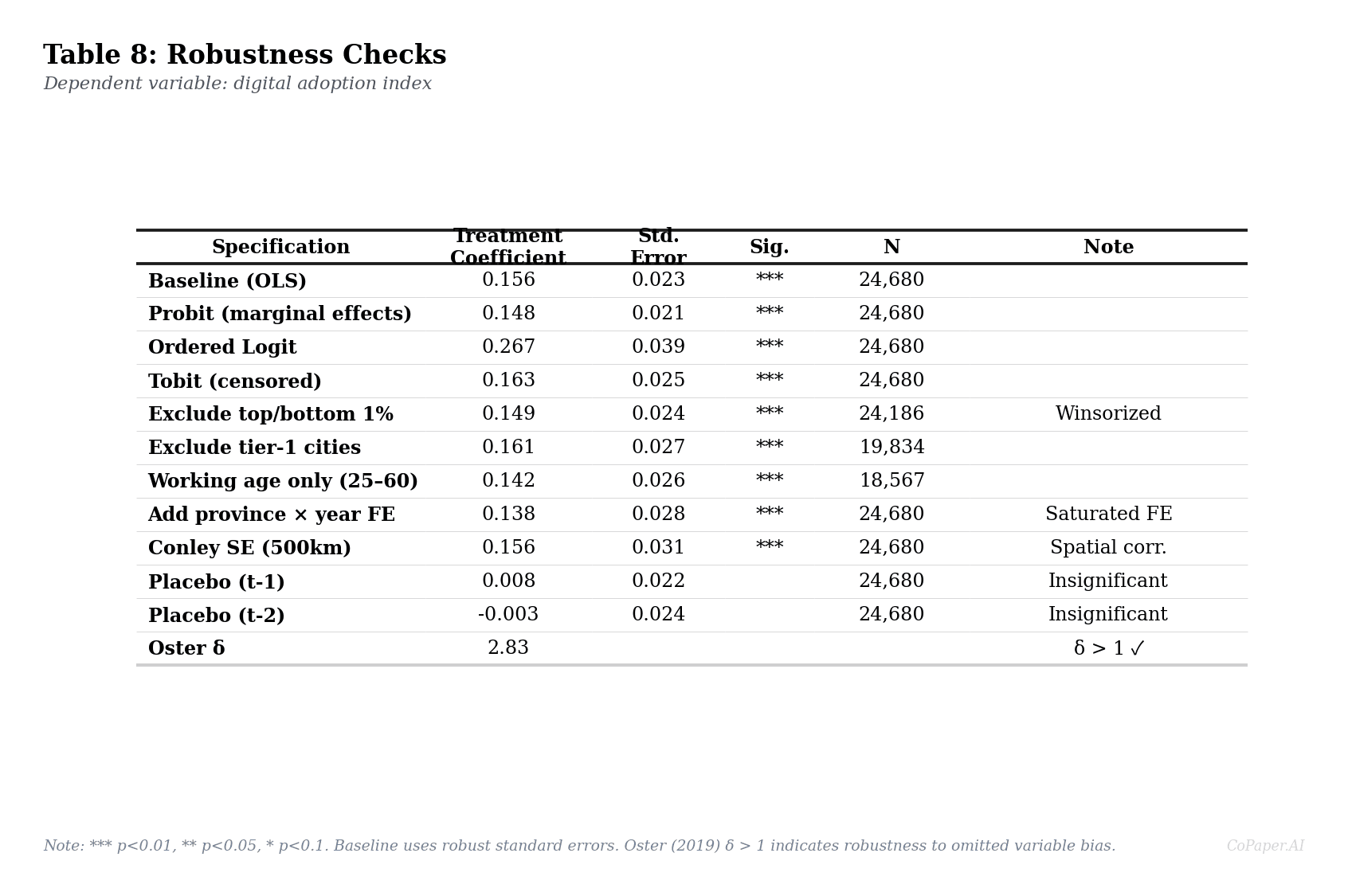
Robustness Checks Summary
Point estimates across alternative specifications — controls, samples, and SE choices — in one glance.
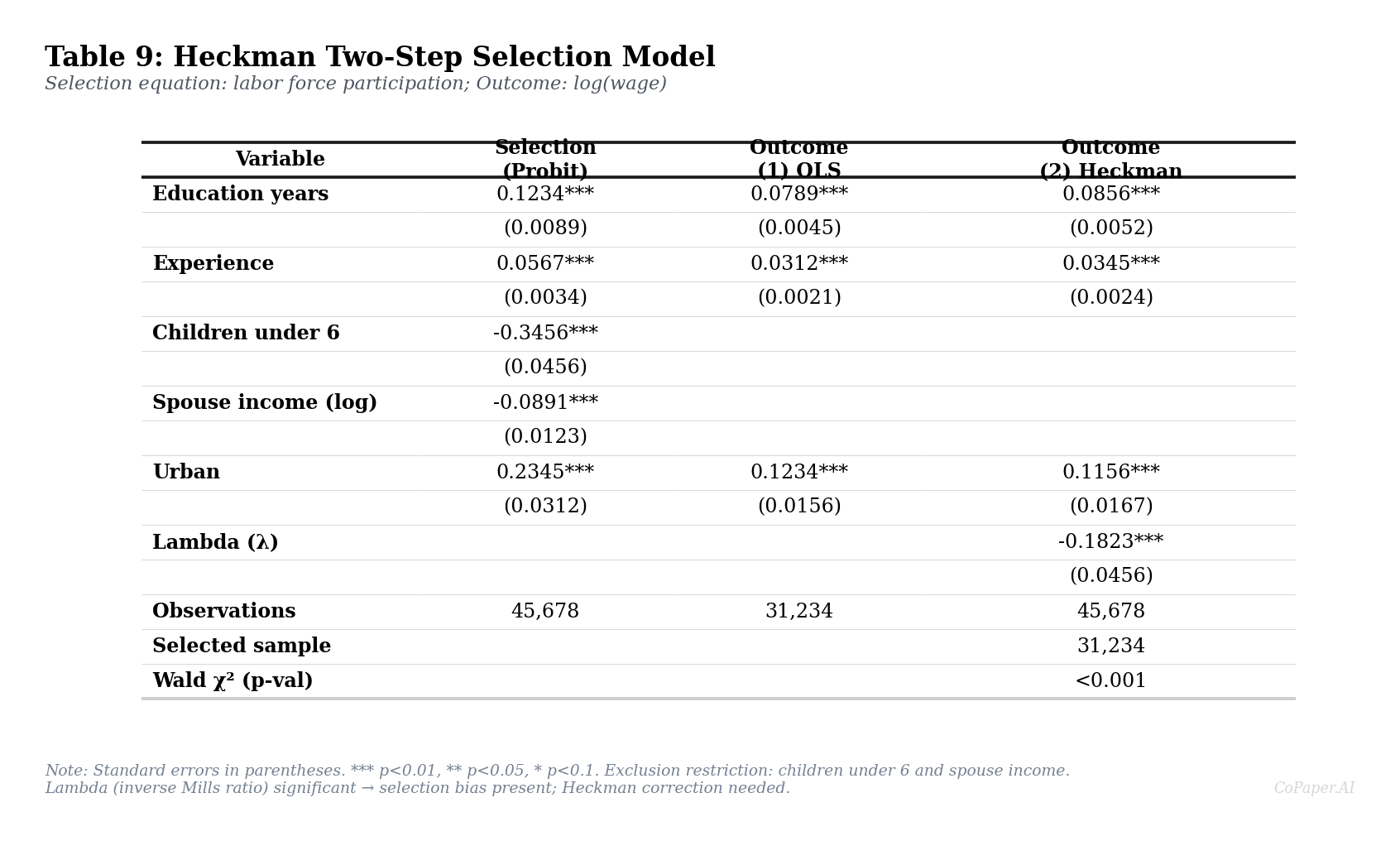
Heckman Selection Model
Two-stage selection correction with inverse Mills ratio and selection-equation diagnostics.
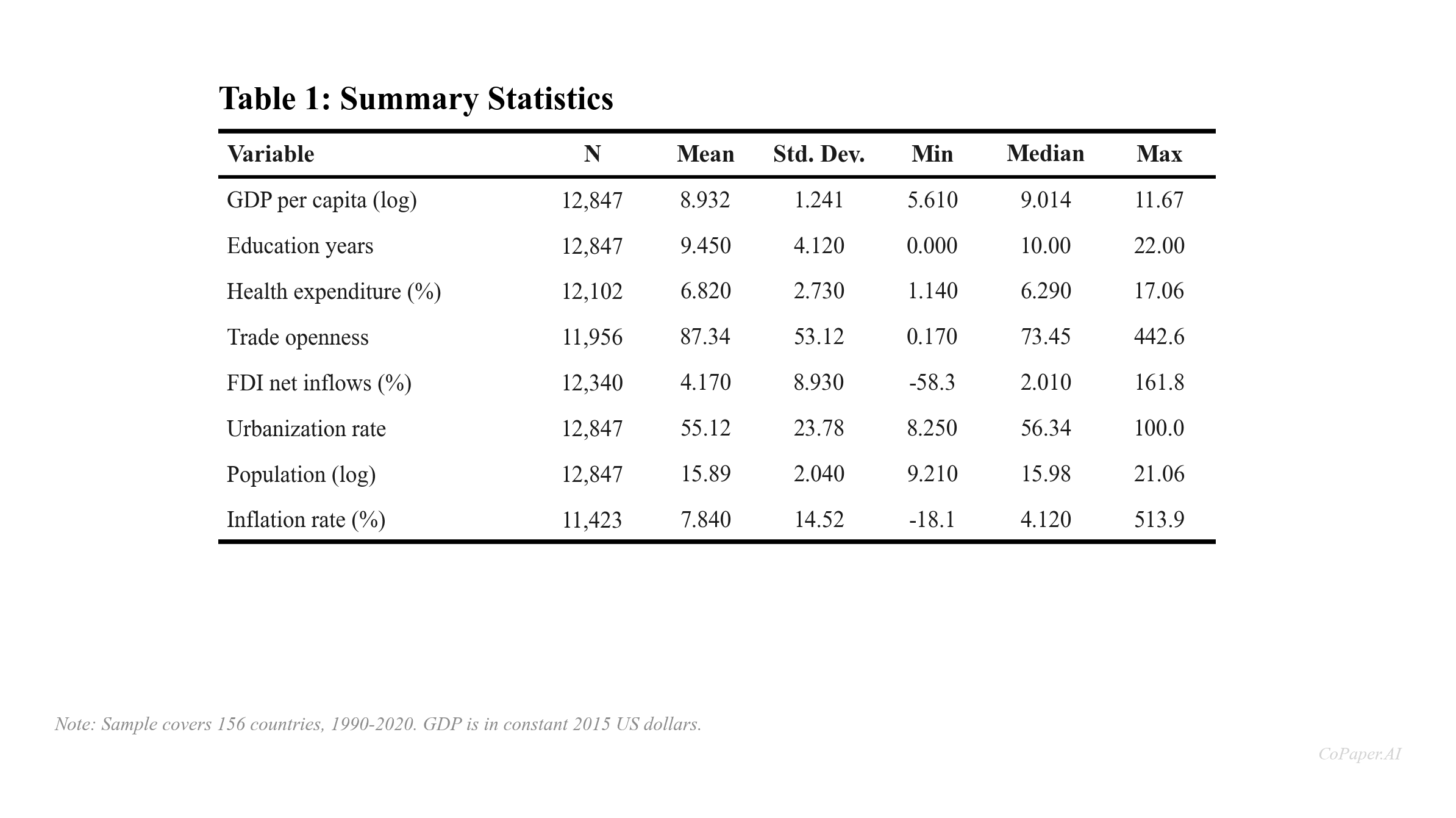
Descriptive Statistics Table
Mean / SD / min / max by group with tests of balance — formatted for direct journal submission.
All figures and tables are sample outputs from real CoPaper.AI runs. Papers delivered as complete, citation-formatted .docx files.
You're the Author, AI Is Your Research Partner
Unlike tools that generate an entire paper with one click, CoPaper.AI pauses at every critical step — outline, variable selection, model specification, result interpretation — and waits for your input. Every decision reflects your academic judgment. The AI handles the heavy lifting; you steer the research.
Features
Full-pipeline AI paper co-authoring
From data upload to paper export — you participate, revise, and control quality at every step.
Multi-Dataset Upload
CSV, Excel, JSON, Parquet and more. Up to 20 datasets simultaneously. Auto-detects Excel multi-sheet files.
Intelligent Data Analysis
Automated EDA, variable definitions, and econometric modeling — OLS, FE, IV, threshold, DiD, RD, mediation, and more.
Human-in-the-Loop Every Step
Pauses at outline, variables, model specs, and interpretation — nothing moves forward without your sign-off.
Fully Reproducible Code
Every number and figure ships with Python code — plus Stata / R / EViews translations for complete reproducibility.
Publication-Ready Papers
Properly structured .docx with intro, literature review, data & methods, empirical results, and discussion — journal-ready.
AI Refinement & Review
Multi-pass polish and review — tightens prose, checks consistency across sections, and flags weak claims.
Four steps to your paper
Upload Data
Drag and drop your datasets (CSV, Excel, Stata, and more). The system automatically detects variable types and data structure.
Set Research Direction
Define your research question, choose methods, and select variables. Use AI-assisted inference or set everything manually.
AI Writes, You Guide
The AI generates each chapter step by step, pausing after every section for your review and feedback before continuing.
Refine & Export
Polish your paper with AI-powered refinement. Export a complete, publication-ready DOCX with one click.
100% Reproducible
Every regression, chart, and statistical result comes with complete Python code — plus Stata, R, and EViews translations for full reproducibility.
Human-in-the-Loop at Every Step
AI doesn't decide for you. At each stage — outline, data analysis, results interpretation — you review, revise, and approve before moving forward.
Publication-Ready Output
Generates properly structured papers with introduction, literature review, data & methods, empirical results, and discussion — ready for journal submission.
Real Impact
Real users, real outcomes
CoPaper.AI has helped researchers cross the finish line — from journal submission, to modeling competitions, to thesis defense.
Journal Publications
Multiple users have completed empirical analyses and paper writing through CoPaper.AI, successfully publishing in academic journals. Reproducible code and standardized format significantly improved submission efficiency.
Modeling Competition Awards
Users leveraged CoPaper.AI's rapid data analysis and paper generation to achieve outstanding results in empirical modeling competitions — prize-winning work turned around in hours instead of weeks.
Thesis Completion & Graduation
Undergraduate, master's, and PhD students used CoPaper.AI to complete empirical chapters and full theses — from research design to defense-ready drafts, all reproducible from code.

The agent-native causal inference toolkit for the AI era
StatsPAI brings R's Causal Inference Task View and Stata's core econometrics commands into a single, consistent Python API — 800+ functions, one import, purpose-built for LLM-driven research workflows while remaining fully ergonomic for human researchers.
800+
Functions
450+
Public API Surface
MIT
License
3.9→3.13
Python Support
Agent-Native by Design
Every function ships with a self-describing schema — list_functions(), describe_function(), function_schema() — ready for OpenAI / Anthropic tool-calling out of the box.
One Import, 800+ Functions
DiD, RD, synthetic control, matching, DML, causal forests, neural causal, causal discovery, policy learning — all under sp.* with one consistent CausalResult object.
2025–2026 Frontier Methods
Callaway-Sant'Anna, Borusyak-Hull-Jaravel, Park-Xu shift-share IV, particle-filter assimilation, Bayesian causal forest — all re-implemented from the original papers.
Publication-Ready Pipeline
Word + Excel + LaTeX + HTML + Markdown export from every estimator. No more outreg2 / modelsummary dance — just .to_latex() and you're done.
Head-to-Head
vs Stata, R, and legacy Python
StatsPAI consolidates what used to require a $695/yr Stata license plus 20+ incompatible R packages — into one agent-native Python API.
| Capability | Stata | R | Python (legacy) | StatsPAI |
|---|---|---|---|---|
| Unified API across methods | ||||
| Agent-native schemas (LLM tool calling) | ||||
| Modern ML causal (DML, forest, TMLE) | ||||
| Neural causal (TARNet, CFRNet, DragonNet) | ||||
| Word + LaTeX + Excel publication output | ||||
| One-call robustness (spec_curve, assumption_audit) | ||||
| Cost | $695+/yr | Free | Free | Free |
| Open source (MIT) |
Built for LLMs, ergonomic for humans
Stata and R were designed for humans with keyboards. StatsPAI is the first econometrics toolkit designed from the ground up for AI agents — while being just as clean to drive manually.
- Every one of the 800+ estimators exposes an OpenAI / Anthropic tool-calling schema via function_schema().
- Every result is a structured CausalResult object with .summary() / .plot() / .to_latex() / .cite() — no fragile string parsing.
- Ships with an MCP server scaffold so Claude, ChatGPT, and custom agents can drive the full library via natural language.
import statspai as sp

# 1. LLM discovers 800+ estimators
schemas = sp.list_functions()

# 2. Self-describing tool schema
spec = sp.function_schema("callaway_santanna")
#  → OpenAI / Anthropic tool-calling ready

# 3. Agent invokes — structured result
res = sp.callaway_santanna(data=df, ...)
res.summary()     # console
res.to_latex()    # publication
res.plot()        # figure
res.cite()        # bibtex
Proof, Not Promises
See it on GitHub & PyPI
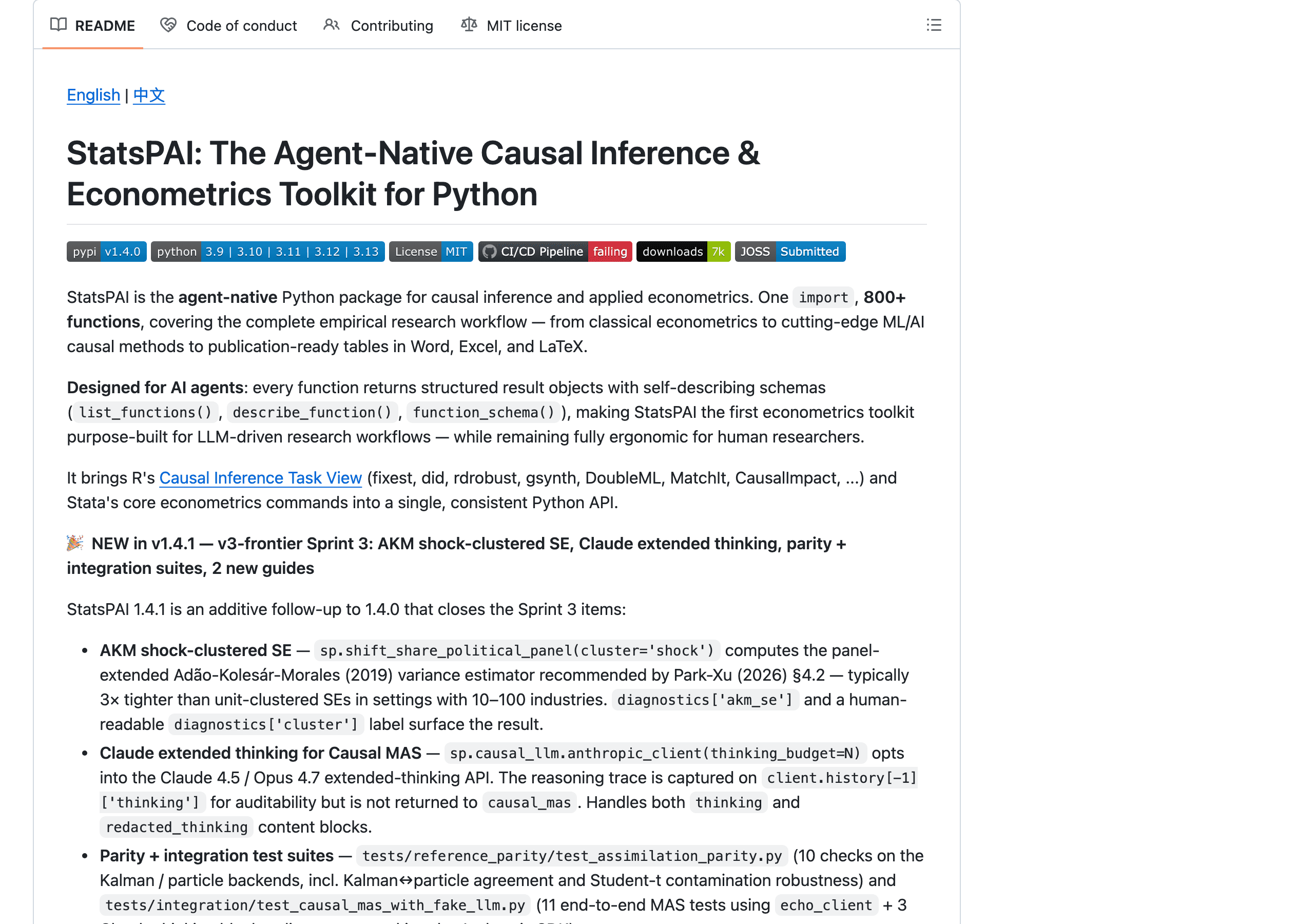
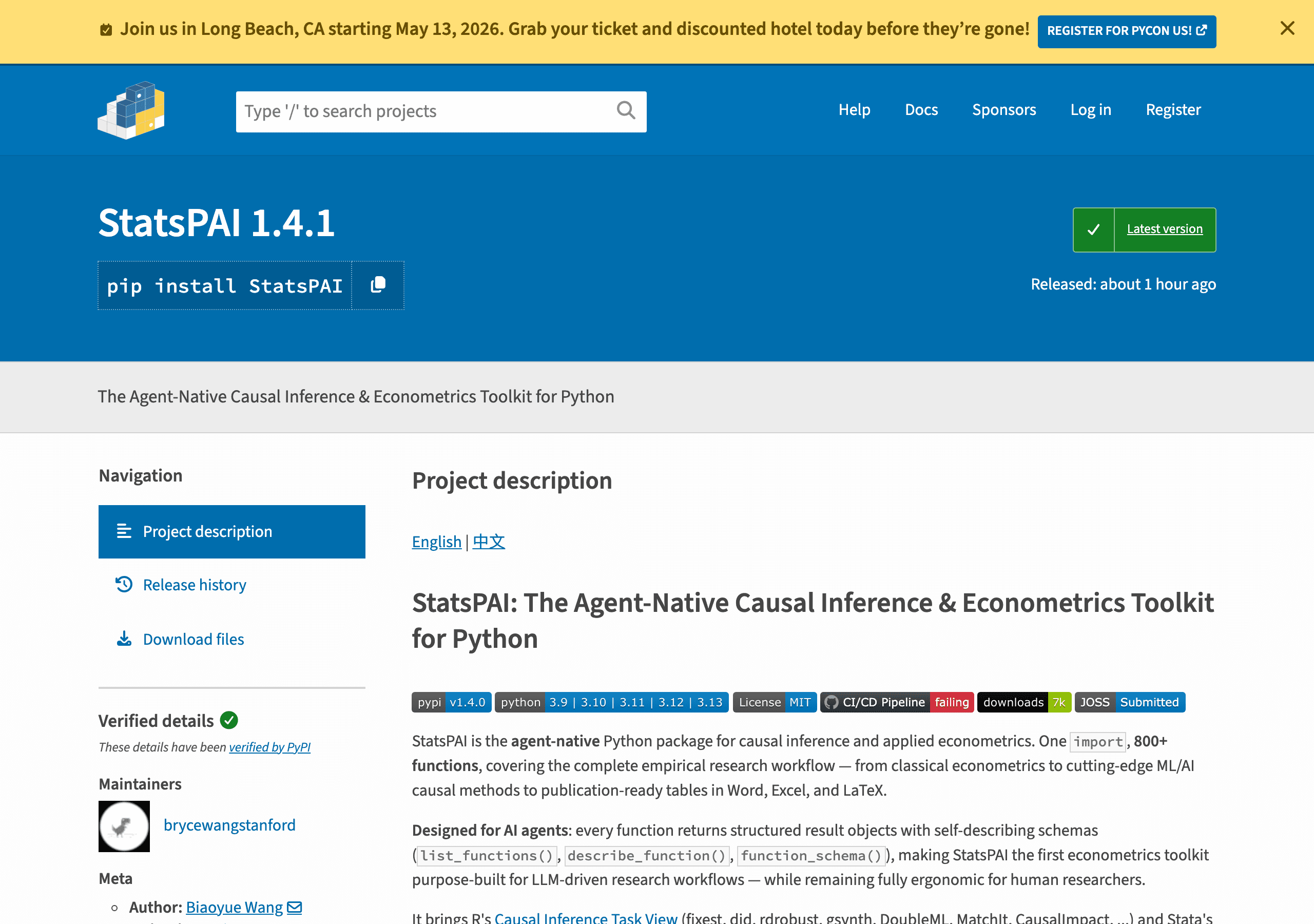
A fast-moving, fully open-source project — 279+ commits, 54+ stars, 9+ releases, and a JOSS submission underway.
To become the #1 causal inference tool of the AI era
The last 40 years of causal inference were built in Stata and R — closed, paid, and designed for human hands. The next 40 will be built in Python, open-source, and agent-native. StatsPAI is the foundation: one import, every frontier method, every result machine-readable, every table publication-ready — so the next generation of researchers and their AI collaborators can move at the speed of thought.
From Basics to Advanced Agent Systems
Deep Dive into Agentic AI

Building Intelligent Multi-Agent Systems
A comprehensive guide to understanding and implementing intelligent multi-agent systems. Goes beyond drag-and-drop workflows to teach dynamic, intelligent decision-making in AI systems.
“AI era, understanding is king. Abandon non-essential details, directly reach the core of Agentic AI thinking.”
Get in Touch
Get in Touch
Ready to transform your research workflow?
Join researchers worldwide who are accelerating their empirical analysis with StatsPAI.